
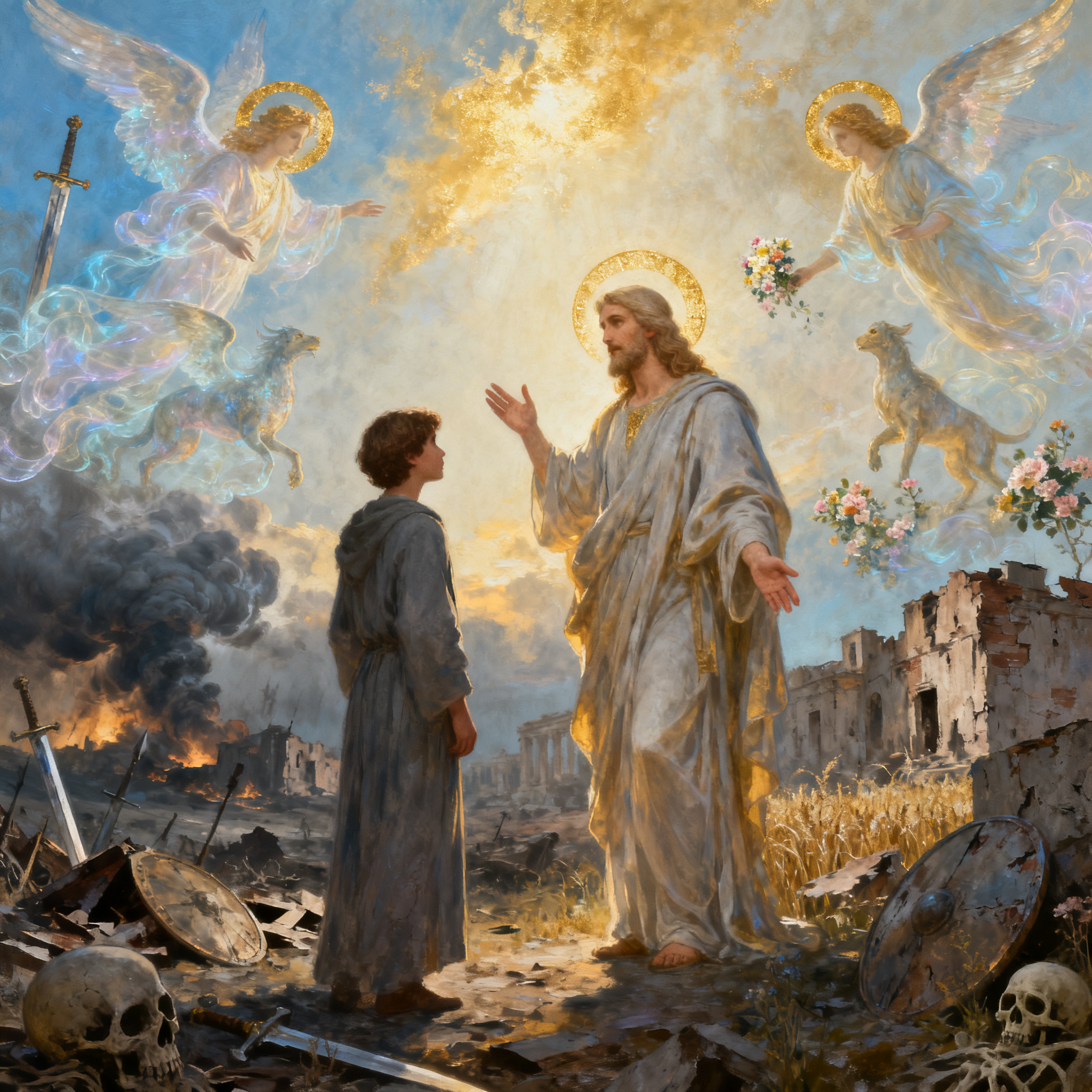
Nelson sees it’s John the Beloved who is the friend of Jesus. He asked, “Why are you here and where’s Caleb?” John told him. “I’m here to witness the end of the world where Jesus will come back to judge the living and the dead.” Nelson isn’t religious himself, but it doesn’t matter really considering that he can accept anything. Me and Nelson have been friends since Middle School. We’ve been inseparable since. Nelson said, “And the second question, where’s Caleb?” John answered, “I’m sorry, but I know not. You see I was sent here to write down all my visions to benefit all of mankind. I’ve seen many great signs, the horrors of Conquest, war, famine, and death, the splendor of angels, and the rise of the beasts of the water and the earth.”
This dream possesses a distinctly biblical and eschatological theme, with echoes of the Book of Revelation. Here's a detailed interpretation of the dream's various elements:
John the Beloved: Often identified as John the Apostle, traditionally believed to be the author of the Book of Revelation. His presence in the dream suggests themes of prophecy, revelation, and possibly, the unveiling of hidden truths or future events. John serves as a symbolic link to divine knowledge and insight.
Witnessing the End of the World: This is a profoundly universal archetype that represents a transformative phase or a significant change in the dreamer's life. It could symbolize an upheaval that is personal, emotional, or spiritual, akin to an 'end' of the familiar and a beginning of the unknown. This motif often appears when individuals are coping with uncertainty or significant life transitions.
Jesus' Return and Judgment: Even though Nelson isn't religious, this imagery may represent a subconscious exploration of accountability, morality, or a search for meaning. Judgment doesn't have to imply a theological stance; it could symbolize introspection, self-evaluation, or seeking forgiveness and reconciliation in relationships.
Search for Caleb: Caleb's absence is a focal point for Nelson, indicating an unresolved issue, unexplored potential, or perhaps a part of Nelson's life or identity that feels missing or disconnected. Caleb might represent trust, loyalty, or even unresolved aspects of their relationship or inner self.
John’s Mission of Vision Recording: This element suggests that the dreamer is processing vast, perhaps overwhelming ideas or life changes. The focus on writing down visions implies a desire for communication, clarification, or legacy. The dream could be urging Nelson to document, express, or clarify his own thoughts or feelings for the future benefit.
Symbols of Conquest, War, Famine, and Death: These apocalyptic horsemen are often metaphors for personal struggles, fears, or challenges that the dreamer perceives as daunting or inevitable. They are universal symbols of trials that one might feel approaching or currently facing.
Splendor of Angels & Rise of the Beasts: The contrast between the divine splendor and the threatening beasts might represent the dichotomy between good and evil, hope versus despair, or the eternal struggle between one's better nature against darker impulses or external challenges.
The Presence of Long-Time Friendship: The mention of an enduring friendship with you provides a grounding contrast to the dream's more fantastical elements. It suggests that amidst uncertainty, friendships and familiar relationships are anchors, providing support and continuity.
In summary, this dream taps into profound themes of insight, transformation, inner conflict, and resolution. For Nelson, the dream might symbolize navigating significant life changes or grappling with deep existential questions, anchored by the comforting reality of enduring companionship. It encourages introspection, reconciliation with past or present issues, and an openness to change and growth.